Rolling Back Inclusion: Tracking the Assault on Community Development
This resource tracks the new federal attacks on inclusive community development here, along with state-level measures enabled and encouraged by the new federal context.
READ MORE >January 2017
The Democracy Collaborative
climate change, community development, social justice
Smart Growth Fixes for Climate Adaptation and Resilience
This publication seeks to help local government officials, staff, and boards find strategies to prepare for climate change impacts through land use and building policies. The policy options described here bring multiple short- and long-term environmental, economic, health, and societal benefits that can not only prepare a community and its residents and businesses for the impacts of climate change, but also improve everyday life.
READ MORE >January 2017
United States Environmental Protection Agency
climate change, transit-oriented development
Californians’ Views on Climate Change
This new set of public opinion data deals with Californians’ views on climate change.
READ MORE >January 2017
Public Policy Institute of California
clean energy, climate change
Dangerous by Design 2016
The fourth edition of this report once again ranks the most dangerous places for people walking by a “Pedestrian Danger Index,” or PDI. It also explores who is most at risk of being struck and killed by a car while walking, including data that looks at pedestrians by age, race, ethnicity, and income.
READ MORE >January 2017
Smart Growth America
transportation, walking and bicycling
The How and Why of Measuring Access to Opportunity: A Guide to Performance Management
This resource provides the data, tools, and methodologies transportation officials need to measure access to opportunity so this can be made part of planning and investment decisions.
READ MORE >January 2017
Smart Growth America
economic opportunity, social justice, transportation
The Curb-Cut Effect
Laws and programs designed to benefit vulnerable groups, such as the disabled or people of color, often end up benefiting all of society. There’s an ingrained societal suspicion that intentionally supporting one group in society hurts another. That equity is a zero sum game. In fact, when the nation targets support where it is needed most – when we create the circumstances that allow those who have been left behind to participate and contribute fully – everyone wins.
READ MORE >January 2017
Standford Social Innovation Review
economic opportunity, social justice
California’s Housing Future: Challenges and Opportunities
This report outlines California’s housing challenges and potential housing affordability solutions. It provides the data and analysis to describe the problem and frame the discussion surrounding solutions.
READ MORE >January 2017
from Governor Jerry Brown; the California Business, Consumer, and Housing Department; and the California Housing and Community Development Department
affordable housing
California’s San Joaquin Valley: A Region and Its Children Under Stress
This report documents racial and health inequities and the effects that they have on the lives and life chances of families raising children in the San Joaquin Valley.
READ MORE >January 2017
Sierra Health Foundation and the W.K. Kellogg Foundation
public health, social justice
Physical Activity: Health Benefits, the Role of the Built Environment, and Impacts of Air Pollution
This paper summarizes and updates the findings of the Physical Activity Guidelines for Americans Committee Report, commissioned by the U.S. Department of Health and Human Services. It concludes by focusing on areas of physical activity and health research which are pertinent to the California Air Resources Board’s (ARB) mission to protect and promote public health by reducing air pollution exposure.
READ MORE >December 2016
California Air Resources Board (ARB)
public health
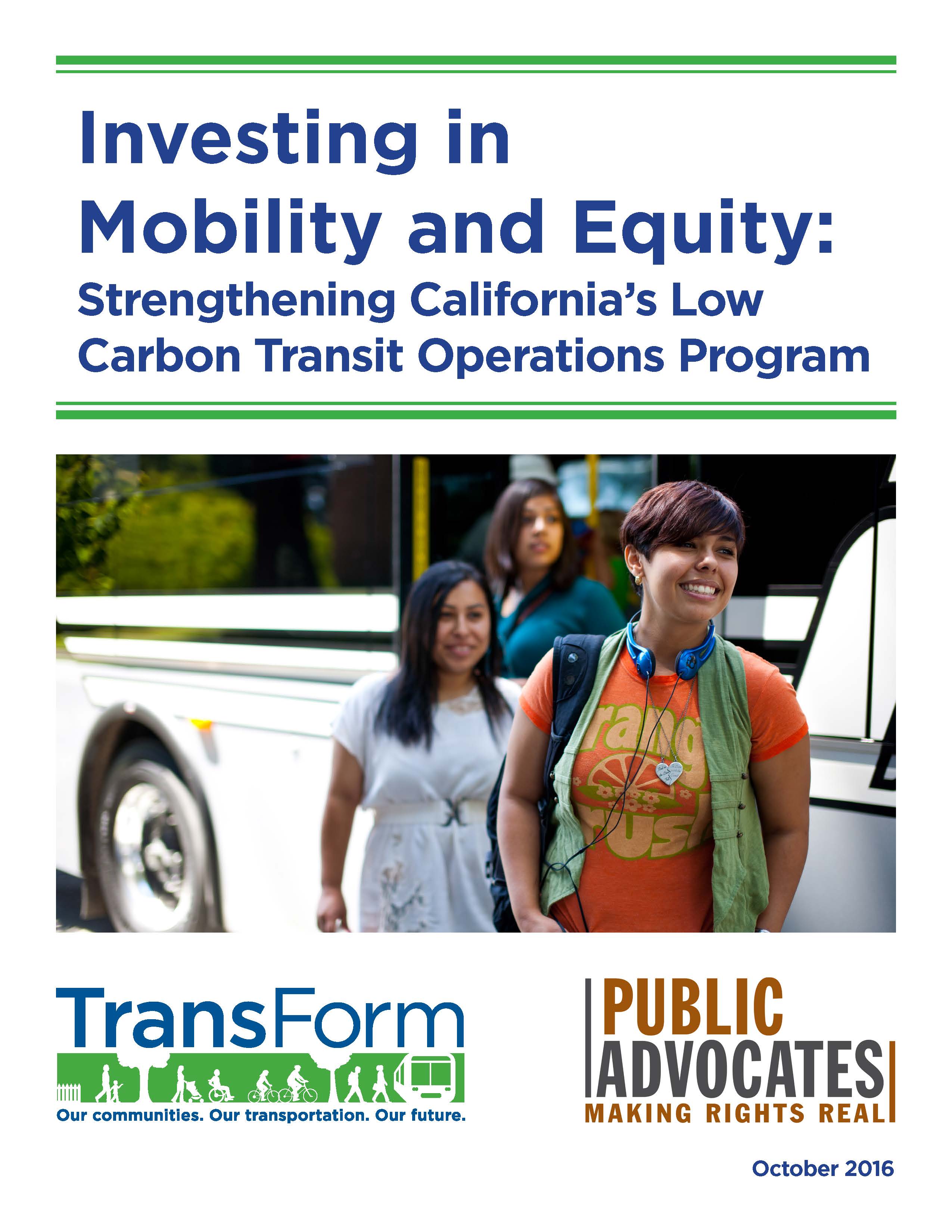
Investing in Mobility and Equity: Strengthening California’s Low Carbon Transit Operating Program
This looks at the first two years of California’s Low Carbon Transit Operating Program (LCTOP). The report assesses whether and how transit service and capital projects funded by the LCTOP meet the goals of the program to reduce greenhouse gas emissions and enhance transit mobility, particularly for residents of disadvantaged communities and low-income populations.
READ MORE >October 2016
Public Advocates & TransForm
climate change, economic opportunity, transit-oriented development
Leading the Way: Policies and Practices for Sustainable Communities Strategies
This report for advocates and planners presents some of the best strategies that regions around California have used in developing Sustainable Communities Strategies, including public engagement, funding, planning land-use scenarios, and more.
READ MORE >October 2016
ClimatePlan
climate change, community development, transit-oriented development
Scaling Solutions: Strategies for Building Effective Philanthropy Partnerships
This guide for navigating public-philanthropic partnerships draws on US Housing and Urban Development’s place-based programs which have benefitted from the active engagement of philanthropic partners. These partners are supporting neighborhood revitalization efforts, building multi-stakeholder collaborative and peer networks, and providing technical assistance to help low-capacity communities compete for federal grants and attract private investment.
READ MORE >September 2016
US Department of Housing and Urban Development
community development, economic opportunity, social justice
Health Impact Assessment Toolkit for Planners
This toolkit from the American Planning Association provides guidance on each of the six Health Impact Assessment steps to guide planners through the process of integrating public health considerations into planning.
READ MORE >September 2016
American Planning Association
public health, transit-oriented development
A Preliminary Environmental Equity Assessment of California’s Cap-and-Trade Program
A new report from researchers at the USC Dornsife Program for Environmental and Regional Equity uses data from the California Environmental Protection Agency and the US Census to assess inequalities in the location of greenhouse gas-emitting facilities, as well as the amount of greenhouse gases and particulate matter emitted by facilities regulated under cap-and-trade.
READ MORE >September 2016
University of Southern California
climate change, social justice
Fossil-Free Bay Area
This report explores three big ideas for action by local governments, regional agencies, utilities, and the private sector to significantly reduce fossil fuel use in the Bay Area region.
READ MORE >September 2016
SPUR
climate change