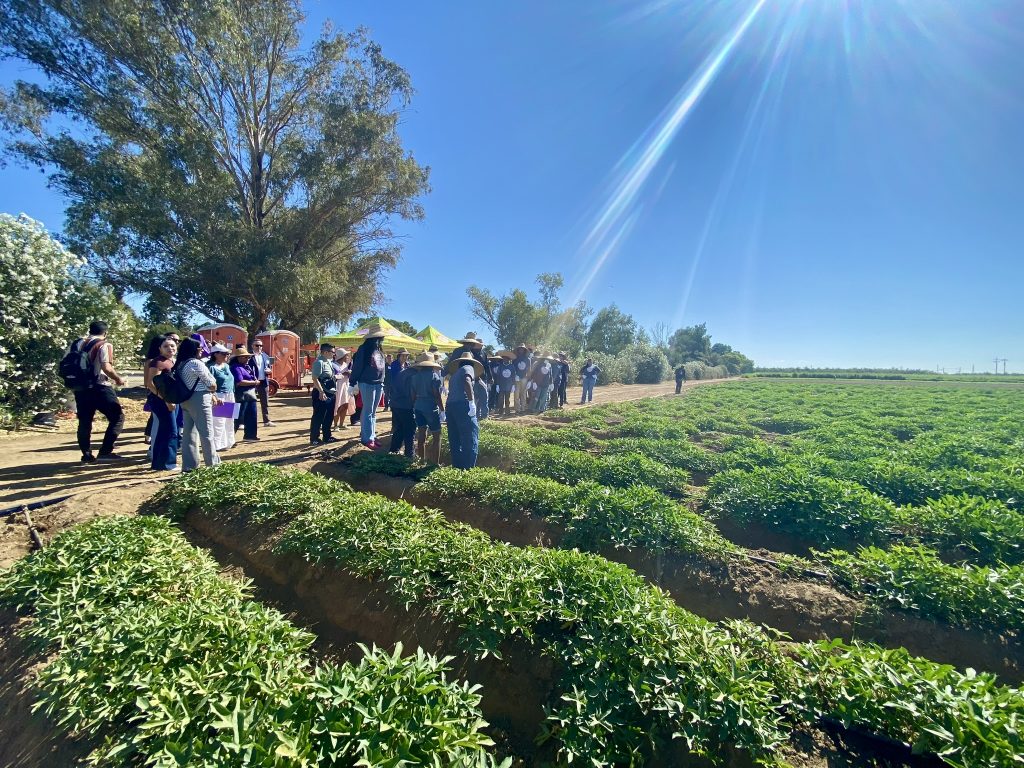
The Sweet Potato Project, a Community Mobilization Economic Initiative (CEMI) grantee in Fresno. Photo by Diana Williams
West Fresno knows what it means to be overlooked. When Valley Children’s Hospital relocated to another community 25 years ago, it left a void in this historically Black neighborhood — demonstrating that essential institutions can vanish, forcing residents to fend for themselves.
In the years that followed, local leaders documented the toll: poorer health, fewer educational opportunities, and jobs and income slipping away.
“Data, data, data — you’ve got to get the numbers to make the case,” said West Fresno native Yolanda Randles, whose evidence helped win state and county backing for new programs like the West Fresno Family Resource Center, which she now leads.
From that groundwork grew community health efforts like the Sweet Potato Project, where young people cultivate both crops and confidence to expand their sense of the future.
Cultivating Skills and Confidence
Solutions like these are exactly what the Community Economic Mobilization Initiative (CEMI) was created to strengthen. Backed by a partnership of California philanthropies, CEMI helps local leadership take root and build the case for greater public investment.
On a recent tour, funders and community leaders saw how the Sweet Potato Project doubles as both a classroom and a training ground, helping young people find their voice and, for many, become the first in their families to graduate.
New Ideas Taking Root
Fresno sits at the heart of one of the nation’s most productive farm regions, so it’s fitting this project starts with agriculture. Students turn sweet potatoes into marketable products while sampling college life at Fresno State. Along the way, they gain mentoring, stipends, and health services to support their journey.
“I wouldn’t have even thought about speaking at something like this when I started,” Kevin, a student, told us. “There’s so much baggage people carry. Here, people listen … help you translate it into the real world … We’re growing a product — but really, it’s about ourselves.”

Students from West Fresno’s Sweet Potato Project
Scaling Local Solutions
The program is one of more than 50 community-driven efforts supported through CEMI. Launched in 2022 and lead by The Center at Sierra Health Foundation, the $22 million initiative is supported by a collaborative including the James Irvine Foundation, The California Endowment, the California Wellness Foundation, Sierra Health Foundation, and Blue Shield Foundation, among others.
CEMI’s goal is to give overlooked communities a fair shot at public funding. With flexible resources, technical assistance, and statewide peer connections, local leaders can sharpen their advocacy, build capacity, and make the case for investment. Yet these gains unfold against a backdrop of shifting federal priorities.
“In the moment we’re in, the resiliency of these grantees is incredible,” said Kendra Lewis, managing director of CEMI. “We go into communities where we should be going — where the people are.”
Turning Vision into Investment
Under Trump’s leadership, historic investments in frontline communities are being dismantled, hitting immigrant communities especially hard as they face mounting crises. But even in this environment, CEMI partners are breaking through.
Community Development Technologies (CD Tech) in South Central Los Angeles won $15 million from California Jobs First; the California Heritage Indigenous Research Project in Nevada City pulled in nearly $1 million from a tribal fund. La Familia Counseling Center in Sacramento won $17 million for a community center that would hlep residents withstand extreme weather events — then saw that the award stripped away as part of a sweeping federal rollback, now tied up in lawsuits.
These wins show what’s possible — and the setbacks show how shaky it all is. As the loss of Valley Children’s Hospital revealed, when support disappears it leaves communities exposed. That’s why CEMI focuses on building the strength of community members — so resilience comes from the ground up, not from a single institution or grant.
From Thrift to Transformation
Back in Fresno, our tour stopped at another CEMI grantee — Neighborhood Recycling, partly housed in an old Nabisco warehouse.
Standing amidst forklifts and stacks of boxes, founder Anthony “AP” Armour recalled how a $20 thrifted fur coat gave him a much-needed boost in high school. Orphaned at 12 and having spent time on the streets, he came to value thrifting and built it into a business grounded in dignity and opportunity.
“When you grow up in trauma, confidence comes at a premium,” he said.
Second Chances, Real Jobs
Today, Neighborhood Recycling processes more than five million pounds of donations a year, running two thrift stores and a warehouse where clothing and household items are sorted and sold. More than a recycling hub, it’s a training ground where people impacted by the justice system or with limited education find a path forward through job training.
“The most powerful certificate we have is a paystub,” Armour said.
Among the visitors was labor icon Dolores Huerta, who praised Armour’s work — and said she loves thrifting

Labor leader Dolores Huerta with Sierra Health Foundation President Chet Hewitt
Reflections on Risk and Resilience
After the tours, we reflected on what it takes to move visions from fragile beginnings to lasting institutions. Money, yes — but also faith in local wisdom.
When CEMI started, “it was just a vision,” said Judi Lopez of The California Endowment. “Visions are great, but you have to implement them. We said ‘yes’ because we thought about what risks are worth it. At the end of the day, we have to take smart risks.”
Her words echoed what we had seen all day: by resourcing ideas already rooted in communities, CEMI is making smart bets. Instead of prescribing answers, it strengthens organizations with funding, peer support, and technical assistance — helping them navigate challenges that may look very different, or strikingly similar, depending on the place.
In a sector that often talks about breaking down barriers and speaking honestly across geographies and institutions, CEMI is making that space real.
What’s Next
To learn more about CEMI and its statewide grantees, join an upcoming CEMI gathering onOctober 16th in Los Angeles (register here).
To view a map of all 53 CEMI grantees — along with a full list of who they are — click here.
Diana Williams is program manager for Smart Growth California and leads the San Joaquin Valley Funders’ Collaborative, whose members include the Sierra Health Foundation, the Irvine Foundation and the California Wellness Foundation.
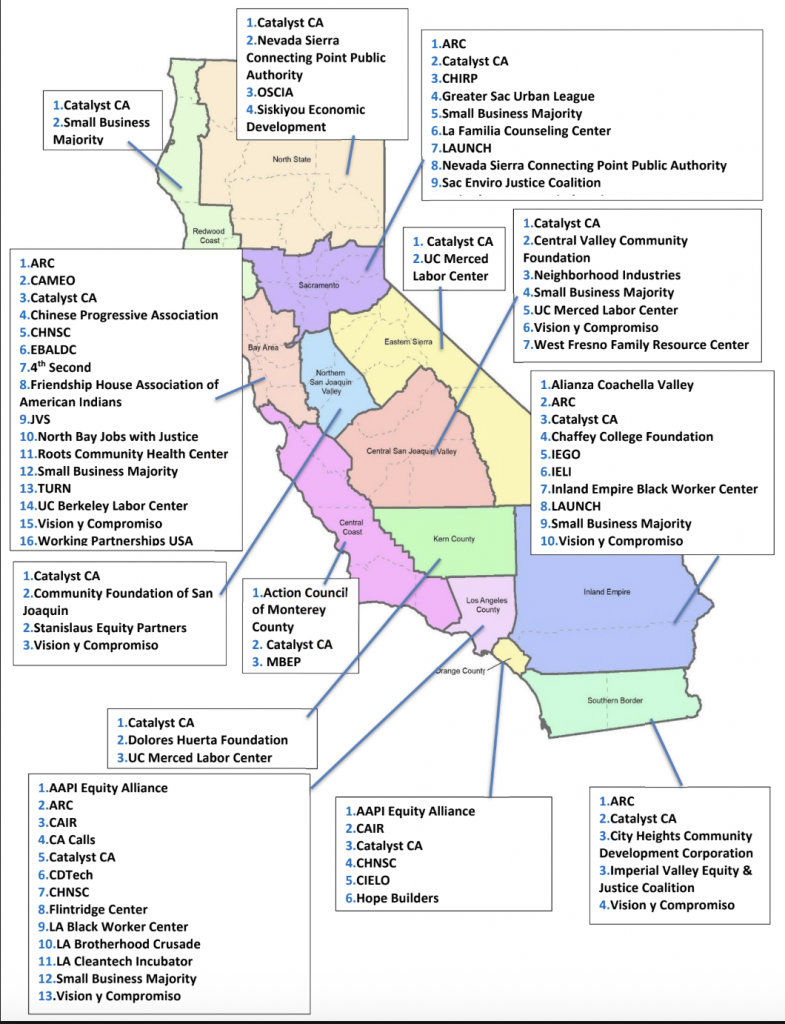
The 53 CEMI grantees span California.