Too often, rural Northern California is treated as monolithic. But across 19 rural counties—from Humboldt’s redwood coast to Butte’s foothills and beyond—the North State is made up of distinct communities, histories, and economies. Leaders from Tribal, Hmong, Black, Latino, agricultural, faith-based, and other communities want philanthropy to see the region not only for its challenges, but for the work already underway to shape what comes next—and they’re building solutions that fit where they live.
At our recent Rural Funders Working Group meeting, we heard from leaders of the emerging North State Inclusive Economic Development Collective, the first regional BIPOC-led economic development collaborative in rural Northern California.
The Collective brings together a dozen organizations across distances, sectors and cultures. Their goal is to strengthen collaboration, expand economic opportunity, and help communities shape shared priorities for the North State’s future.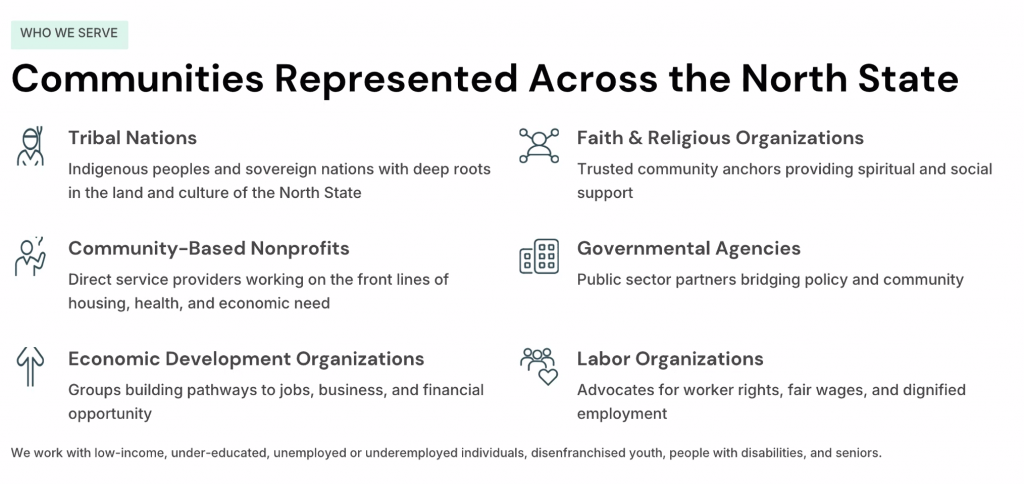
A More Layered Rural Story
“We are committed to changing the narrative of the North State,” Norma Lacy of Northern Valley Catholic Social Services said. “We are growing in diversity.” One priority for the Collective is improving data that documents disparities in communities of color across the region.
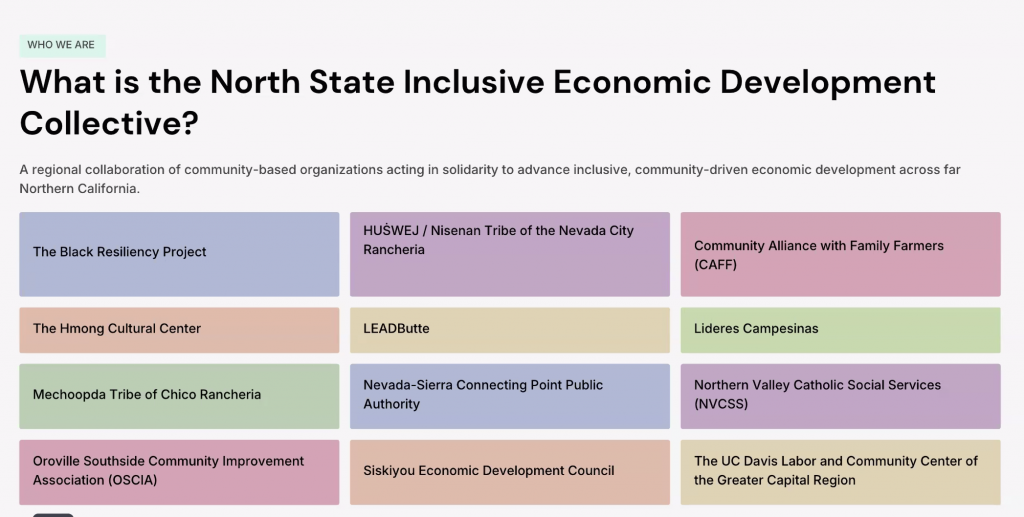
Rural America is becoming more racially and ethnically diverse, and the North State’s story is more layered than broad rural demographics often suggest. Recent data show that per capita personal income in the North State remains well below national and state averages, while poverty rose from 15.0 to 16.2 percent, with higher poverty rates among Black, Asian, Hispanic/Latino, American Indian and Alaska Native, and multiracial residents.
The Collective’s speakers reflected that fuller picture. They included Keesha Hill of Connecting Point, a joint powers authority serving Nevada and Sierra counties that connects residents to health, human services, employment, and community resources; Pastor Kevin Thompson and Lisa Torres of the Oroville Southside Community Improvement Association, a community-based nonprofit offering youth, food security, housing, employment, and community programs; Karla Avila of the Community Alliance with Family Farmers, which supports family farmers and more sustainable food and farming systems; and Lindsay Bellows of HúsWéj, a tribally guided nonprofit supporting the Nisenan Tribe of the Nevada City Rancheria through land rematriation, cultural revitalization, and community wellness.
Together, they described a coalition grounded in the knowledge, relationships, and day-to-day work of North State communities — leaders who understand both the barriers their communities face and the opportunities already emerging across the region.
Three Priorities for Community-Driven Development
The Collective is focused on three core areas: supporting low-income workers and entrepreneurs, advancing affordable housing, and protecting and growing community-owned assets, such as Tribal land, agricultural assets, and cultural centers.
“We realize that we’re stronger together,” said Hill, adding that through their collaboration, they have been asking: “How do we leverage each other’s strengths and use the relationships we have to improve things for all?”
The coalition began with about half a dozen grantees from the Sierra Health Foundation’s Community Economic Mobilization Initiative (CEMI) and soon attracted other groups that saw value in coming together. It is now 12 organizations strong.
“This is a group of unusual allies,” said Bellows. “We come together from different cultures and different places despite living in a system that would seek to divide us. Instead, we’re coming together to serve BIPOC communities.”
An Invitation for Funders to Learn on the Ground
The conversation previewed the North State Funders Tour & Solidarity Economics Gathering, which will include two related events, both in Oroville: The afternoon of August 17, community leaders and regional partners will gather for a Solidarity Economics deep-dive with UC Professor Chris Benner. Funders are welcome to sit in on that conversation, but it is geared towards Collective members. The evening of August 17 there will be a funders’ dinner for those in town; on August 18, funders will be taken on a bus tour to look in-depth at some of the projects under way within the Collective. Co-sponsored by the Collective, The Funders Network’s Smart Growth California, and CEMI, the gathering will help funders learn directly from community leaders and explore regional investment opportunities rooted in community priorities.
Register here. For more information, contact Erika Katske at ekatske@ucsc.edu.
If you’d like to join the Rural Funders Working Group’s future meetings (September 29 and December 8, both from 1:00–2:30 p.m. PT), or if you would like a recording of the June 23 webinar, Across Miles, Cultures, and Causes: Investing in Rural California, contact diana@fundersnetwork.org.