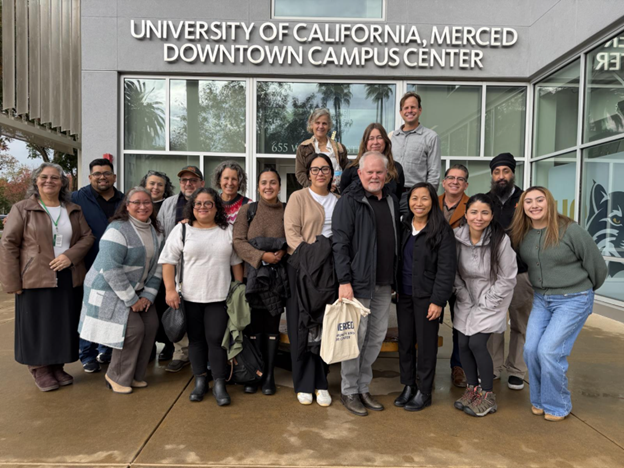
Our recent visit to Merced kicked off with a problem that’s still unresolved: nearly two years after historic floods devastated the unincorporated community of Planada, many families are still rebuilding their lives. For the San Joaquin Valley Funders’ Collaborative, the stories we heard in Planada reflect a pattern we see across the region — communities with the least access to resources and political power often struggle to secure the protections they need.

Dr. Ed Flores (standing) explains the places and history we’re driving past in Merced.
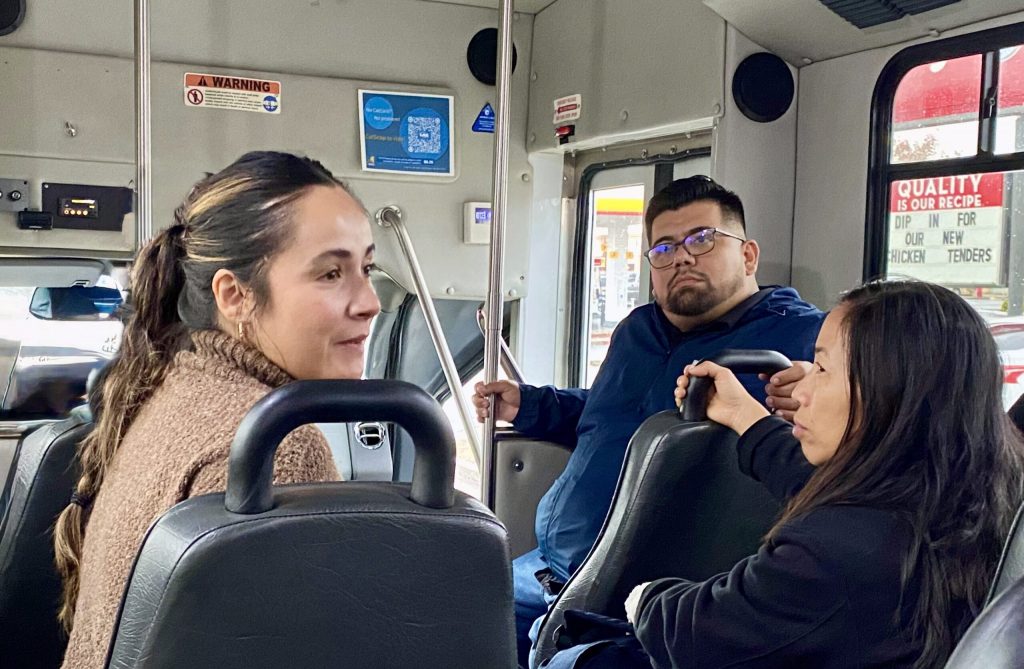
Lety Valencia – Faith in the Valley (left), with MaiKa Yang, Alejandro Carrillo (UCM Labor Center (right))
Youth and Diversity Shape the Future
We kicked off our learning visit over a meal downtown with Prof. Ed Flores, academic director of the UC Merced Community and Labor Center. He explained that Merced has one of the youngest and most diverse populations in the state, with many residents speaking Spanish or other languages at home and lower levels of formal education. Those factors help show where investment could matter most. He added that the Labor Center is the nation’s largest center focused on rural issues, giving the Valley a key resource for understanding jobs and economic conditions.
Turning Research into Action
The next morning, Labor Center Executive Director Ana Padilla and Program Director Ingrid Brostrom walked us through how the center weaves together worker justice, community-engaged research, leadership development and policy work to ensure decisions about the Valley’s economy are grounded in both data and workers’ lived experience.
Lifting the Region, Raising the Stakes
Their work sits within UC Merced — ranked No. 1 in the nation for social mobility — a university that has opened doors for thousands of first-generation students and strengthened the regional economy. But that success has led to rapid growth that’s increasing pressure on Merced’s already tight housing market, raising questions about affordability across the city. That contrast became clearer when we left campus and spent time in the city itself.
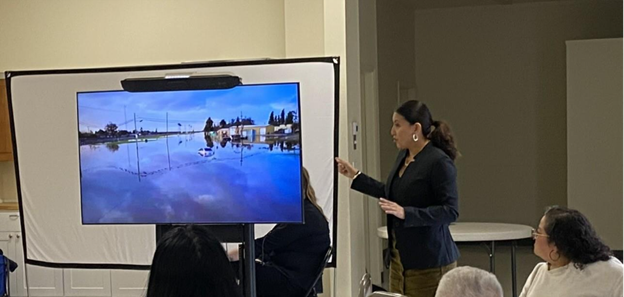
Learning about the Planada flooding and recovery

Hearing from residents at the Planada Community Center about the flooding and recovery
Planada’s Flood Experience
One of the most powerful parts of the visit was traveling to Planada, a small unincorporated community still rebuilding from the 2023 floods. With guidance from Alejandro Carrillo of the Labor Center, Claudio Corchado of Cultiva Central Valley, and Sol Rivas of Valley Onward, we met with residents who described waking in the night to rising floodwaters and the confusing and inconsistent support that followed. We heard stories of extraordinary neighbor-to-neighbor care alongside deep frustration that promised assistance often fell short. Without major infrastructure improvements, many fear flooding could happen again.

At a housing complex in Merced, advocates and tenants shared how they are fighting for their rights.
What Tenants Are Up Against
Later, with organizers from Faith in the Valley, we visited a housing complex in Merced where tenants described worsening conditions and rising rents. Advocates noted that regional growth over the past two decades — including development around UC Merced — increased housing demand without adding stronger renter protections. One long-time resident invited us into her home, explaining that she and her neighbors have no clear contact for their absentee landlord, believed to be an out-of-state investment trust. Several residents have received eviction notices after requesting basic repairs.
Local Food, Local Farmers
At lunch (easily the best meal of our visit), UC Merced Executive Chef Mitch Vanagten talked about the Valley’s agricultural backbone and the university’s efforts to source more of its food locally. His remarks highlighted how agriculture still drives the regional economy and how institutions can support local growers through their purchasing choices.
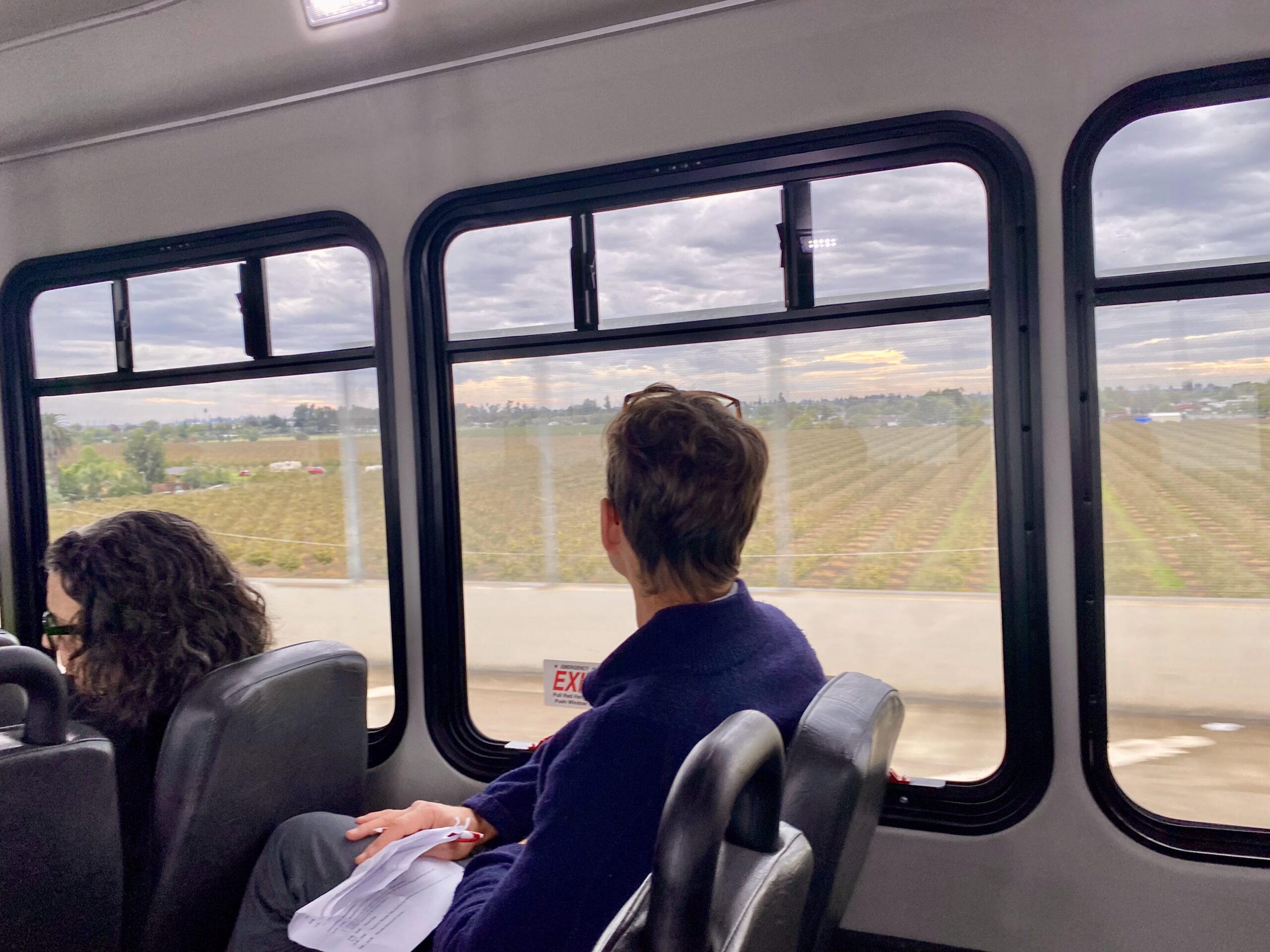
Rolling farmland passes by the window as we drive through Merced County.
One of California’s Rarest Landscapes
We also heard from Joy Baccei, director of UC Merced’s Vernal Pools and Grassland Reserve, and Reyn Akiona of Valley Eco, who shared photos and stories from the reserve since rain kept us from visiting in person. They explained that the vernal pools north of campus are part of one of the last and largest landscapes in California and described efforts to build a wildlife corridor from Yosemite to the Coast Range. Their insights showed how Merced’s natural systems guide conservation and land-use choices.
Where the Workforce is Headed
Our final session brought together leaders from Líderes Campesinas (Suget López), the Jakara Movement (Deep Singh), United Domestic Workers (Sandra Plascencia-Rodriguez), Valley Onward (Sol Rivas), and Faith in the Valley (Lety Valencia). They described shifting workforce realities — from farm labor transitions to warehouse growth to the rise of care work — and the organizing strategies communities are using to navigate them. A discussion of new federal trucking regulations, which could bar tens of thousands of immigrant workers from commercial licenses, underscored how national policy changes ripple through the Valley’s economy and daily life.

Marni Rosen and Mark Valentine
Looking Ahead
Funders left Merced with a deeper appreciation for the region’s resilience, complexity and emerging leadership. Merced, like many Valley communities, faces long-standing challenges but is driven forward by people who know the terrain and are shaping what comes next.
Diana Williams runs the San Joaquin Valley Funders’ Collaborative, which meets bi-monthly. For more information, reach out to diana@fundersnetwork.org.