
Rural communities in California, and nationwide, are reeling from federal workforce cuts that threaten jobs, incomes, and already-strained safety nets. These pressures came into sharp focus at a recent Rural Funders’ Working Group gathering with Patty Hernandez, co-founder and executive director of Headwaters Economics.
“This is a time of belt tightening,” Hernandez told funders. “We want to be really thoughtful and deliberate about the investments that can yield big impacts.”
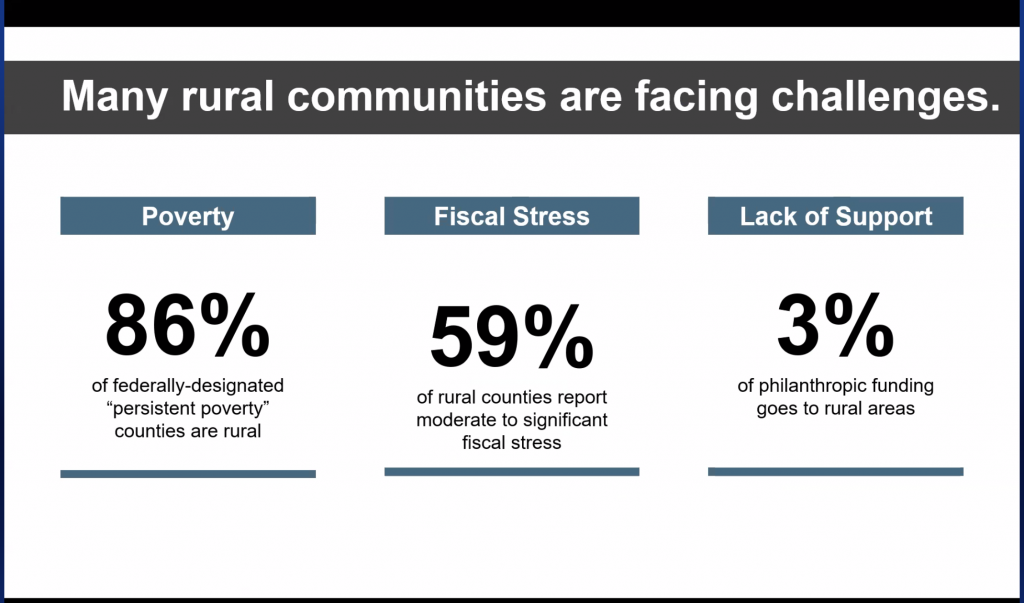
With shrinking budgets, wildfire and other climate disasters, and limited local capacity, small towns nationwide are under strain, and California’s rural communities are no exception.
Making it Count
Hernandez, whose firm is a national leader in research on rural trends and issues, outlined three strategies, including tools like the Rural Capacity Index, for effective funding in challenging times.
She emphasized the importance of strengthening cross-sector capacity, particularly within local governments, given their authority to enact policies and raise revenue.
“If the local government is not brought along then you will simply fall short of improving people’s lives and making investments that bring long-term safety, security, and economic opportunity,” she told funders. Philanthropy can have an outsized impact by investing in local capacity and technical assistance.
Three strategies to guide rural funders:
- Data-Informed Grantmaking
Even funders committed to rural places benefit from tools that show where capacity is weakest. Too often, Hernandez noted, the lowest-capacity communities are still overlooked.
Headwaters’ Rural Capacity Index highlights counties and towns that fall below the national median across 12 measures of economic, civic, and government strength — from staffing levels and broadband access to voter turnout and poverty rates.
Paired with climate risk data, the index reveals that nearly half of the lowest-capacity communities face high flood or wildfire risk, and one in five faces both. Many of these areas — from the West and Midwest to the Gulf Coast and Southeast — are flagged for support to strengthen infrastructure, expand broadband, improve education, and build climate resilience.
One example: the Montana Community Foundation shifted its approach using the index, ultimately funding applications from low-capacity communities at twice the rate of higher-capacity ones.
- Support Sustainable Local Revenue
With federal funds shrinking, local governments must develop new revenue sources — yet many are unprepared for the complexity. Because they hold unique legal authority to undertake community development and revenue generation, local governments need to be part of the solution, Hernandez said.
Ideally, she said, philanthropy is supporting a place’s larger ecosystem that includes community-based organizations along with government institutions, helping them get to more durable solutions than either could achieve alone.
An example: After devastating floods, Livingston, Montana had no plan or funding to improve its stormwater system. Technical assistance to determine options resulted in a new stormwater utility fee that now generates $500,000 annually for infrastructure and safety.
- Matchmake Across Sectors and Geographies
Foundations are uniquely positioned to connect people, ideas, and resources across sectors and regions — and to support projects that deliver shared benefits.
In Fremont, Nebraska, introductions facilitated by the Margaret A. Cargill Foundation led to a partnership among community-based organizations to create an emergency alert system and new shelters for Spanish-speaking residents in flood-prone areas.
“We arrived at this project and made progress because of the introductions” from funders, Hernandez noted.
Closer to home, a partnership between Mono County and Mammoth Lakes ensured that investments in outdoor amenities benefited both the relatively well-financed town and nearby rural areas with fewer resources.
Where Philanthropy Can Lead
Philanthropy can’t replace lost federal resources, but it can strengthen the scaffolding that allows rural communities to stand on their own. By investing in local capacity and forging partnerships across sectors, funders can help ensure these communities weather today’s pressures while building toward a more resilient future.
For those who missed the session, Hernandez’ PPT can be seen here.
Diana Williams is Program Manager for Smart Growth California and leads the Rural Funders’ Working Group, which next meets Nov. 18th from 2-3:30 PM.